

Fact #12
I'm cheating--I don't know if these are really facts about me or just a recap, but oh well.
What I did today:
Woke up. Cleaned the bathroom. Showered. Got in bed and read. Blog surfed. Unplugged the modem and gave it to my sister to hide. Read some more. Wrote half a paragraph. Looked at my edited hard copy and tried to figure out how to pull the stuff Advisor wanted out of the notes and put it into the text. Took a nap.
Woke up. Got the modem back for 20 minutes. Checked e-mail. Tried to find critiques of George Borjas--advisor is wary of him and I mentioned him by name at the end of the chapter. Flipped through some blogs. Re-surrendered modem. Played tic-tac-toe, inventive scrabble (rules? we don't need no stinkin' rules!), and read _Giddy Grandma_ with The Kid. Tried to entice him to start reading _Second Cousins_ .
Went to Chili's. Decided to try, once again, to "get a buzz" (I've never been drunk. High either, but I'm way too scared for that anyway. Didn't start drinking until I was 23 (trust me, that's significant for a Louisianan :-) and, before tonight, never had more than 2 drinks in one night.). Had a strawberry margarita. Had an amaretto sour. Came home. Had a Parrot Bay thingy. All I got was somewhat sleepy. Flopped across the bed. Gave The Kid and nephew permission to sleep on an air mattress in the living room.
Strangest thing happened: an ex, for whom I still have a sweet affection, called just to chat. an ex, with whom I have a child, called to ask why I'm not interested in his life. an almost ex (he better quit messing with me!) called to reiterate that he's tired of my being generous with everyone else and selfish with him, to emphasize that I need to grow up (hah!), and to inform me that, unless I get some "little boy" whom I "can run all over," I'm going to "end up alone" Perhaps I will be pissed about this tomorrow, but apparently the alcohol did have some effect as all I said was, "Mmm, okay," and then, at his primadonna-ish gasp, "Well, what do you want me to say?!" My selfishness, IMO, amounts to the fact that I won't get down and worship him as the most brilliant engineer in the history of history. Two people who are used to being "teh smart" equal ego clashes from hell. He hung up in my face. Brief contemplation of calling him back and invoking attitude. Smug remembrance that, since he is upset, he won't be able to resist calling me to remind me how upset he is.
Responded to e-mail from another TA. Re-surrendered the modem. Broke out the old school, spiral, non-perforated notebook--cuz that's what I do when I'm serious about writing, baby. Wrote a page and four lines. Dozed.
Woke up. Requested modem. Checked e-mail. Checked a coupla favorite blogs. Decided to post. Realized I'm wide awake at 2 a.m. Realized my mom, in town for her class reunion, never called me back last night. Reminded myself that I am a mother who insists a woman's life does not have to revolve around her children--especially her grown ass children--and thus my pout because I wanted to see my mom and she's busy doing ridiculous things like having fun with her classmates is totally hypocritical.
Will re-surrender modem. Will climb into bed with John Higham and an article about Slavic coal miners and transnational or translocal or transsomething something. Will fall asleep around 6 am and be bitchy all day tomorrow/today.
See you then.
Subscribe To

 Posts
All Comments
Sunday, October 15, 2006


Friday, October 13, 2006
Dissertation Thoughts
Trying to brainstorm, bear with me. **Did a little shifting so this could be on top**
So, in revisiting the end of this chapter, I have to consider, once again, the evidence that, at least in issues surrounding the workplace, blacks and immigrants from Latin American countries don't generally build strong coalitions. Hard in an industry that has always been hostile to"traditional" worker organization via unions--in my study, unions have disappointed many black workers (by either being ineffectual in the face of company policy/pressure or by seeming to side with the company) and have been unable to reach Latino workers (b/c of lack of communication and the fact that many work through subcontractors and thus are not eligible for union membership)--and whose management encourages and sometimes sows the seeds of intergroup conflict and tension.
But the problems don't all come from above. There is real resentment on the part of some black workers and a recent study suggested that many Latino immigrants come to the US with negative stereotypes of blacks already firmly embedded. Add to that competition over schools, neighborhoods, and any other number of spaces, and cooperation seems highly unlikely.
Yesterday, in the midst of considering all this, it occurred to me--as Advisor so commonly says--that in studying this, I wasn't reinventing the wheel. Many of the problems between these two groups mirror the issues between black and white workers in the late 19th/early 20th century (and possibly beyond). But here is where my thoughts took a wandering path. In the last couple of decades (or so), historians have argued very convincingly that white workers--even the poorest of the poor--were not wholly manipulated into an unwillingness to build coalitions with black workers. Instead ( and this a very simplistic, rough approximation of a very complicated argument), they were willing to ignore common class issues in the interests of racial solidarity (and this didn't begin in the 19th century). In other words, they accepted, believed in, helped shape white supremacy and the privileging of whiteness and gained just enough from it (even if the gain was ideological) to not cross color lines.
If I compare the black and Latino experiences to that, my question is, if there is no similar privileging of "brownness" (and I don't think there is beyond the issue of "less brown = more better"), what is the overarching reason for the lack of coalition building along class lines? Why is race/ethnicity "trumping" in this particular context, too? I'm thinking that maybe it is related to white supremacy, also, but in a much different way: after years of seeing, and experiencing the wealth of this country in "pie" form, in which the majority group has the dominant share and everyone else is left fighting over a wholly insufficient piece (God, this is a horrible analogy), maybe blacks and Latinos (speaking in a generalized fashion) have accepted the notion that there is a zero-sum game going on, that for one group to advance--get a larger share--another has to take a smaller piece.
I see that, as I work my way through all these sources, reflected in blacks' worries about Latinos being the new, "largest minority group" (whatever that means)--there is a real fear that we will lose whatever political power we had/have, that we will lose powerful whites' attention as they seek to address "Latino" concerns. Conversely, in one sociological study, Latinos expressed some of the same thoughts--that black people had the "ear" of white people, that white people "cared more about" black people, that social services programs were geared for black people.
So the relations, between these two groups is still, in part, being determined in the context of how they understand their relationships with the majority group. But am I discrediting black and Latino agency? Is this way too simple? Does anyone understand what the hell I'm talking about? I had it on my mind and needed to write it out--figured I might as well do it in a context in which I might get feedback.
Update: Y. Carrington has an interesting post so related to what I'm fumbling and bumbling through here.
What the Well-Dressed Historian Is Reading this Weekend
So, since I actually sat down and wrote something in the chapter and thought deeply about it (which I often avoid because my mind goes on tangents), I'm rewarding myself with a little extra reading-while-I-write for this weekend. So, I went to the back of my closet last night and pulled out several things. And just because I'm smugly confident that y'all are way interested in what I read, I'm making a list.
For the Dissertation:
Ehrenreich- Nickeled and Dimed
Green- The World of the Worker
Foley- White Scourge
Meyerowitz- Not June Cleaver (Dorothy Sue Cobble's Article)
Janiewski- Sisterhood Denied
Sidel- Keeping Women and Children Poor
Kim- Koreans in the Hood
Ignatiev- How the Irish Became White
For Personal Enrichment (I have a grad certificate in Women's Studies and as part of the requirements, I had to take some classes outside history. I chose a social work class, "Women's Issues," an English class, "Feminist Theory and Methodology," and a sociology class, "Special Problems: The Family." I'm finally in the mood to actually engage these texts, as I think some will help with the dissertation and some will help me strengthen my self-definition as a scholar of women's history):
hooks- Killing Rage
Hesse-Biber et al- Feminist Approaches to Theory and Methodology
Findlen- Listen Up
Kemps & Squires- Feminisms
Just Because I Love It:
Gray-White- Too Heavy A Load
Will I get to all of these this weekend? Probably not, but I did learn a lot about reading quickly and for main points, arguments, place-in-the-historiography, etc., while I was taking my comprehensive exams. And some of these represent my simply revisiting texts for clarity and because I need them right now--actually, all the dissertation list except the Kim book fall in that category. So I probably will get through those. The feminist texts will be an ongoing thing, though I've already gotten back into hooks. And I'm delighted, because in an essay called "Beyond Black Only," she makes the following assertions:below currently above this one. And, while the book is a decade old, and this essay has probably been analyzed and deconstructed and whatever else it is we academics do, at least I found this.
And in my closet. That place keeps my fashionable trendiness and my academic sensibilities on point. ;-p
***UPDATE: Forgot to mention two things that I have read lately that 1) aren't related to the dissertation and 2) I really admired ("enjoyed" doesn't seem the right word, given the subjects) :
Colombus Day Observed 2006
An Angry Loveletter to WhiteSister
For the Dissertation:
Ehrenreich- Nickeled and Dimed
Green- The World of the Worker
Foley- White Scourge
Meyerowitz- Not June Cleaver (Dorothy Sue Cobble's Article)
Janiewski- Sisterhood Denied
Sidel- Keeping Women and Children Poor
Kim- Koreans in the Hood
Ignatiev- How the Irish Became White
For Personal Enrichment (I have a grad certificate in Women's Studies and as part of the requirements, I had to take some classes outside history. I chose a social work class, "Women's Issues," an English class, "Feminist Theory and Methodology," and a sociology class, "Special Problems: The Family." I'm finally in the mood to actually engage these texts, as I think some will help with the dissertation and some will help me strengthen my self-definition as a scholar of women's history):
hooks- Killing Rage
Hesse-Biber et al- Feminist Approaches to Theory and Methodology
Findlen- Listen Up
Kemps & Squires- Feminisms
Just Because I Love It:
Gray-White- Too Heavy A Load
Will I get to all of these this weekend? Probably not, but I did learn a lot about reading quickly and for main points, arguments, place-in-the-historiography, etc., while I was taking my comprehensive exams. And some of these represent my simply revisiting texts for clarity and because I need them right now--actually, all the dissertation list except the Kim book fall in that category. So I probably will get through those. The feminist texts will be an ongoing thing, though I've already gotten back into hooks. And I'm delighted, because in an essay called "Beyond Black Only," she makes the following assertions:
Bonds of solidarity between people of color are continuously ruptured by our complicity with white racism. Similarly, white immigrants to the United States, both past and present, establish their right to citizenship within white supremacist society... through acts of discrimination and assault that register their contempt for and disregard of black people and darker-skinned immigrants. Concurrently, darker-skinned immigrants mimic this racist behavior....And then she quotes Toni Morrison who says
In race talk, the move into mainstream America always means buying into the notion of American blacks as the real aliens. ...A hostile posture toward resident blacks must be struck at the Americanizing door before it will open.So, I wasn't totally clueless when I was wondering and wandering in the post
And in my closet. That place keeps my fashionable trendiness and my academic sensibilities on point. ;-p
***UPDATE: Forgot to mention two things that I have read lately that 1) aren't related to the dissertation and 2) I really admired ("enjoyed" doesn't seem the right word, given the subjects) :
Colombus Day Observed 2006
An Angry Loveletter to WhiteSister
Canada troops battle 10-ft Afghan marijuana plants
I wasn't going to post anymore today (seeing as how I'm on a reading-and-writing mission and all), but then my co-worker showed me this story.
So now I'm picturing all my blunt-smoking friends, mouths watering, reconsidering their opposition to military service (an opposition wholly supported by the problems they'd encounter with urinalysis). Especially given this astute observation of the burn-the-plants-down strategy:
So now I'm picturing all my blunt-smoking friends, mouths watering, reconsidering their opposition to military service (an opposition wholly supported by the problems they'd encounter with urinalysis). Especially given this astute observation of the burn-the-plants-down strategy:
A couple of brown plants on the edges of some of those (forests) did catch on fire. But a section of soldiers that was downwind from that had some ill effects and decided that was probably not the right course of action."Ill" effects? I'm thinking that's not the right adjective.
Wednesday, October 11, 2006
Blogroll
And no, I don't know what the hell is going on. I don't think it's my new template, though, as each time I go to the blogrolling site, I get a fatal or permanent or some other error message.
Does fatal or permanent mean they died?
Is Elle, the techno-travesty, going to have to go into the template and add all my blog friends?
Does anyone else have a clue?
Does fatal or permanent mean they died?
Is Elle, the techno-travesty, going to have to go into the template and add all my blog friends?
Does anyone else have a clue?
Revisions...
...are proceeding slowly. But, if you know me at all, you expected that. I'm excited though, because I've gotten some suggested readings from a professor who teaches a class on the impact of race, class, and gender on labor history (so my thing) at another Texas university and from Rachel S. (these are going to help me with the framework of the whole thing), some kind words and a tip on tracking down some obscure sources from Steve Striffler, and La Mala is looking at my bit on language as a "conflicted space" between "natives" and "newcomers."
I've also been bugging the other PhD students in my department who study relationships between racial/ethnic groups, because I can go to them and say tell me about this or that in your own words. A good way to get ideas for "who to know" in a particular field, but also to get a feel for what they're saying. That works better for me than book reviews and skimming.
Now if anyone knows how I can get in contact with Dr. Bill Heffernan (I've been trying for a while now, albeit half-heartedly) who used to be at the U of MO-Columbia and who wrote a paper on poultry farmers IN THE LOUISIANA PARISH I'M STUDYING (sorry; there's so little on the industry in this parish that I get excited each time I think about it), I'd be ecstatic.
Monday, October 09, 2006
100 Facts about Elle in 100(ish) Days (11)
Fact #11
Some of the issues I encountered on other blogs * this weekend led me to discoveries about myself: 1) I really am clueless when it comes to the politics of interracial/interethnic conflicts within the so-called left and 2) I probably am as sarcastic as some of my friends claim.
The moral of this story? My mom was right when she said, "Everybody you think is your friend ain't your friend!" and I really should rely more on reason, less on snark.
*I debated on giving that link, but my God! I am still reeling. You have to see BfP's post so that all the misconstruals and misquotes don't fry your brain, though.
Saturday, October 07, 2006
An Open Letter
Dear Sister,
I know you disappeared this weekend under the guise of a professional conference. In some places, that may be acceptable. What I want to know is how in the world you justify leaving me here with these kids alone?! On a weekend when the only kids’ movie that’s playing here, we saw last weekend and the summertime temperatures mean we won’t be pursuing too many outdoor activities.
Friday night wasn’t so bad—it appears even they know the rules about said day and time. But at 8 am this morning, I discovered they have no respect for others’ sleep. I happened to roll over and there was The Kid, peering at me, freaking me the hell out. “Mama,” he said, “May I get on the computer?” to which I responded, “Boy, it is Saturday morning! I am trying to sleep.”
I have vague memories of both of them waking me up more times in the next thirty minutes: “What can we eat? There’s no milk!” and “He’s taking too long in the bathroom!” When I did roll over, their hard-headed asses were on the computer anyway, looking at me all big-eyed and pretending to be frightened. And then your child tried to cover his ass by noting, “He won’t share the computer!”
I instructed them to go do something productive. Wary of my wrath, they decided to clean the living room. Only, they sprayed furniture polish everywhere and neglected to wipe it all up. And somehow, the vacuum magically started smoking and burning. Again, your kid, the consummate ass protector, told me, “I been meaning to tell y’all to buy an new vacuum cleaner.”
Apparently, my surprise trip to the living room broke up some food-sneaking. Your son ran to the bathroom to pee when I appeared. When I went in there, there was the wrapper of an ice cream bar along with the stick in the toilet. And he hadn’t flushed. Since I was not about to stick my hand in, I had to flush three times to make sure it wouldn’t overflow while almost peeing on myself.
But were these shepherds of the devil content there? Oh, no. They began the most annoying tattling—“He passed gas!” “He moved one of your pictures.” “I want a honey bun because he ate some graham crackers.” Oh and my favorite—“He threw that rubber ball in the light thing and the light is on! I smell it!”
And, when I dared ask them why they were acting like maniacs, they shrugged their shoulders. I hate that! So I told them to take a nap. Your son immediately had complaints that wouldn’t let him rest peacefully. “My two fingers hurt,” he said. “Are they broken?” I asked. “No!” “Too bad.” And then he got up to tell me, “My head is soft.” “It sure is,” I agreed.
And so goes the day. I’ve probably revised all of three pages of this chapter. They have had to clean up the same areas repeatedly. They’ve probably only read a combined total of ten words between them. And they keep tattling. “Y’all are not from Louisiana,” I finally told them, “because if somebody was bothering you, you wouldn’t just keep talking about it!” Was I directly encouraging them to fight? No! I was… well, hell, yes, I was!
But I am writing to 1) Let you know this cannot happen again before they are teenagers or before we have a live in nanny and 2) confirm exactly what time you are leaving your hotel. Do you need us to meet you halfway? Do you have enough gas money? Is there anything that may impinge upon your journey back?
Tearfully Prayerfully,
elle
I know you disappeared this weekend under the guise of a professional conference. In some places, that may be acceptable. What I want to know is how in the world you justify leaving me here with these kids alone?! On a weekend when the only kids’ movie that’s playing here, we saw last weekend and the summertime temperatures mean we won’t be pursuing too many outdoor activities.
Friday night wasn’t so bad—it appears even they know the rules about said day and time. But at 8 am this morning, I discovered they have no respect for others’ sleep. I happened to roll over and there was The Kid, peering at me, freaking me the hell out. “Mama,” he said, “May I get on the computer?” to which I responded, “Boy, it is Saturday morning! I am trying to sleep.”
I have vague memories of both of them waking me up more times in the next thirty minutes: “What can we eat? There’s no milk!” and “He’s taking too long in the bathroom!” When I did roll over, their hard-headed asses were on the computer anyway, looking at me all big-eyed and pretending to be frightened. And then your child tried to cover his ass by noting, “He won’t share the computer!”
I instructed them to go do something productive. Wary of my wrath, they decided to clean the living room. Only, they sprayed furniture polish everywhere and neglected to wipe it all up. And somehow, the vacuum magically started smoking and burning. Again, your kid, the consummate ass protector, told me, “I been meaning to tell y’all to buy an new vacuum cleaner.”
Apparently, my surprise trip to the living room broke up some food-sneaking. Your son ran to the bathroom to pee when I appeared. When I went in there, there was the wrapper of an ice cream bar along with the stick in the toilet. And he hadn’t flushed. Since I was not about to stick my hand in, I had to flush three times to make sure it wouldn’t overflow while almost peeing on myself.
But were these shepherds of the devil content there? Oh, no. They began the most annoying tattling—“He passed gas!” “He moved one of your pictures.” “I want a honey bun because he ate some graham crackers.” Oh and my favorite—“He threw that rubber ball in the light thing and the light is on! I smell it!”
And, when I dared ask them why they were acting like maniacs, they shrugged their shoulders. I hate that! So I told them to take a nap. Your son immediately had complaints that wouldn’t let him rest peacefully. “My two fingers hurt,” he said. “Are they broken?” I asked. “No!” “Too bad.” And then he got up to tell me, “My head is soft.” “It sure is,” I agreed.
And so goes the day. I’ve probably revised all of three pages of this chapter. They have had to clean up the same areas repeatedly. They’ve probably only read a combined total of ten words between them. And they keep tattling. “Y’all are not from Louisiana,” I finally told them, “because if somebody was bothering you, you wouldn’t just keep talking about it!” Was I directly encouraging them to fight? No! I was… well, hell, yes, I was!
But I am writing to 1) Let you know this cannot happen again before they are teenagers or before we have a live in nanny and 2) confirm exactly what time you are leaving your hotel. Do you need us to meet you halfway? Do you have enough gas money? Is there anything that may impinge upon your journey back?
elle
Yes, No, or Maybe
Lord, Have Mercy! I gotta share this before I get my nose back to the grindstone.
Yesterday, my nephew got his first "Yes, No, or Maybe," note from a girl. Without the maybe. This girl doesn't have time for waivering!
He is in the FIRST grade! The note (I deleted nephew's name):
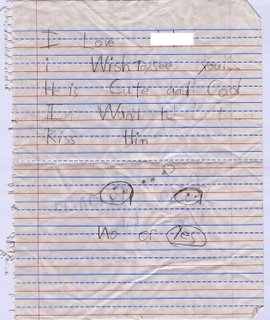 My response (verbatim): "This little girl in first grade, too? Her fast ass! I bet her parents don't know. And you done circled "yes"? Your mannish butt. Y'all too grown!"
This little girl is sharp, y'all, which is why I hope she puts her energy into something other than gaining a boyfriend! How do I know that? Let's look at the note:
1. Aside from some punctuation and capitalization issues, this is pretty well-written for a child in the 2nd month of first grade. Trust me.
2. On her illustration, the little girl has eyelashes. I know kids pick up on that on cartoons and dolls and such (eyelashes = girl) but to pick up on it then express it yourself? I don't see that too often with 6-year-olds.
3. The little girl also has a thought bubble! Apparently those thoughts are focused on love, but still.
I really do wonder what her parents would think.
Yesterday, my nephew got his first "Yes, No, or Maybe," note from a girl. Without the maybe. This girl doesn't have time for waivering!
He is in the FIRST grade! The note (I deleted nephew's name):
 My response (verbatim): "This little girl in first grade, too? Her fast ass! I bet her parents don't know. And you done circled "yes"? Your mannish butt. Y'all too grown!"
This little girl is sharp, y'all, which is why I hope she puts her energy into something other than gaining a boyfriend! How do I know that? Let's look at the note:
1. Aside from some punctuation and capitalization issues, this is pretty well-written for a child in the 2nd month of first grade. Trust me.
2. On her illustration, the little girl has eyelashes. I know kids pick up on that on cartoons and dolls and such (eyelashes = girl) but to pick up on it then express it yourself? I don't see that too often with 6-year-olds.
3. The little girl also has a thought bubble! Apparently those thoughts are focused on love, but still.
I really do wonder what her parents would think.
100 Facts about Elle in 100(ish) days (10)
Fact #10
My dad has me addicted to the Don Pendleton's The Executioner books. I love Mack Bolan. If you know of him at all, you know why that may be problematic with my stances on some issues.
Actually, my dad is the reason I'm a voracious reader. Not only did I pilfer his Executioners, I read his romance novels (he loved the sweet Harlequins), a few Louis L'Amours, and a Western series (of which, I can't think of the name right now, but they always had a big drawing of the hero's face on front and he had an almost-handlebar, black moustache).
Fun times.
Thursday, October 05, 2006
Scratch My Earlier Confusion...
I totally get the TX ban on sex toys now. Via Feministe:
The study said women were more likely to reach orgasm if they used sex toys... Use of sex toys and orgasm in women may indicate a link between orgasm and sexual interest or adventurousness.Cuz women pleasing themselves? Totally unacceptable.
Making it from Doctoral Student to PhD
A while ago, C.N. Le had a nice post on helping minority doctoral students to succeed. It seems universities are doing better jobs of attracting us, but a not so good one at keeping us. I wanted to post about my own experiences in a general sense--my goal is not to offend anyone, but to make some light bulbs click on! I also know, as I always try to acknowledge, that all these issues are not related solely to my race, but to the fact that I'm a woman coming from an immediate family in which there was little familiarity with college experiences--and none with graduate studies.
Le quoted the following:
Family and first generational issues--No one in my family knew what the hell I was getting myself into. While they are largely supportive, there are the jokes about my career student status. I don't laugh those off. In fact, they make me feel sort of ashamed, as if I'm somehow not yet a contributing member to society. So there's always been this pressure to hurry up in order to avoid the questions, raised eyebrows, and disapproving murmurs. To this group of working people, I am strange--over 30 and still in school. And while my immediate family is usually much more supportive, my mom asked me about the dissertation, "How long can that take to write? Can't you just sit down and do it?" And there is my dad's opinion that the only valid doctor is an MD. With my brain, I could've done something "bigger" in his opinion, been a "real" doctor or a lawyer. Underscoring my mom and dad's observations is a theory that I am lacking organization and drive--if I put my mind to it, I can hammer out this dissertation or I could've overcome my aversion to science.
I don't think people in the department here understand my familial obligations either. Last year, Advisor was horrified that I was going to be my son's room parent. "You can't," she said, "You need to be spending big chunks of time in front of the computer."
But I have a kid. That is my simplistic, and in my opinion, wholly explanatory response. I have a kid-one who demands lots and lots of time. I have to clean house, I have to think about dinner. Just as validly, I want to accompany him on field trips, I want to visit his classroom, I want to be an active part of the PTO. She is a mother, but her experience is different--I was 23 and in the middle of an MA when I had my kid; she was late 30s or so and already in possession of the PhD. So, her priorities, while she was working on the PhD were, understandably, different. She could put the degree before all else. I cannot. Truthfully, I will not. I mean, it's my kid, and I'm not getting this time back.
Advisor also hates the fact that I work in the summer (to tell you the truth, I didn't even let on that I worked this past one). It takes time away from my writing she argues and she is 100% correct. But again, I don't think she focuses on the fact that I'm a single mother with BILLS! I cannot live without income from July to October. It's just not feasible. Under her watchful eye, I have refrained from teaching outside classes during the school year, but things get excruciatingly tight sometimes and I can't do all the things I'd like to do for the kid.
I think there is also an idea that you can turn off obligations, forget all norms of reciprocity because you're doing such great, important work. Recently, I asked a colleague a question for a friend of mine who's researching this area. He's been here forever, so I figured he might have insight. He took my e-mail as a chance to scold me:
Inadequate educational preparation: Wholly my own fault, but a factor nonetheless. I switched from thesis option to terminal degree after I had my son. Thus, much of what probably seems apathy or lack of... something, is genuinely a lack of knowlege of how to do this, namely, how to write a dissertation. I'm lucky enough to make the grade on writing, but the research--it's usually after I finish a chapter that I realize I need to go here or there or find this or include more about that, etc. They need to offer a seminar, a class, something!! on how to do this. I am still in the dark on a number of issues. Hopefully, I manage to stumble my way out of the halls of academia.
“Chilly” departmental climates: Brrrrr. When I got here, my initial advisor was off campus for the year. So, they dropped Elle, the woefully unprepared, into this huge department to fend for herself. I picked my own classes. I ruminated on my topic. I didn't socialize with the cool kids (like Quinn. In fact--Quinn was ultra-intimidating b/c she was my age, but light years ahead of me in historical knowledge! I hated her :-). And I wandered way off. In fact, had the graduate advising assistant not liked me from the beginning, I would've been back in Louisiana with a quickness.
But, Advisor, thank God, had already taken a slight interest in me, so she helped me. And, over the next two years, it became clear we could work together. Actually another professor from whom I took some independent studies, told me "She's interested in being your advisor but she doesn't want to step on any toes," and told Advisor, "She's interested in being your advisee but doesn't know if you want the extra work. Advisor also worried that I would feel the need to remain loyal to the initial advisor b/c she was black, too. Honestly, I had wanted to work with a black woman, but it just didn't work out. Plus, Advisor is brilliant and unafraid to crack the whip--two things I definitely need. Initial advisor remains on my committee and is friendly.
There was also an issue, early in my PhD program career that I won't disclose much about here, that involved the questioning of my ability--not because I performed poorly, but because I performed so well. And while I'd like to think that my work is just that unbelievable, part of me wonders, had I not been black, would the questions have been asked?
But speaking of chilly, my advisor is a Northerner. I am a Southerner. Not to speak in stereotypes, but there have been times when her abrupt tone has made me vow to never ask her anything again! But then she says things like, "You know, we think you hung the moon and stars," and I get all agreeable again. Seriously, learning not to take everything personally, to not fear that a chapter is going to be so poorly written that she's going to regret ever having taken me on, is hard.
Finally, when I started, I don't know who else was in the writing phase and thus not on campus, but I was the only visible black PhD student in the program (the numbers have "swelled" to around 4 or so). If you've never had an acute sense of being way different--despite very sincere attempts to make me feel part of the department and the grad student cliques--try that.
Given all that, you may be saying, well, Elle, what keeps you there? For that, there are a number of factors, too.
Pride (Quit now? Please!), My Dissertator Group (can someone say sanity via e-mail?), Advisor (because, you know, she thinks I hung the moon or something), I Like my Topic (I just wish someone else would write it), Graduate Advising Assistant (she's been with me since application days!), and I really, really, really love history.
No smart addendums for that one.
Le quoted the following:
Data revealed that these minority doctoral students encounter a variety of potential barriers, including family and first generational issues, inadequate educational preparation, unclear institutional policies and procedures and “chilly” departmental climates. Overwhelmingly, issues associated with race/ethnicity permeated every cultural and institutional barrier identified in this study. . . .Let's see: family and first generational issues, check, inadequate educational preparation, check, chilly departmental climate, sorta check--I'll explain in a moment.
This study suggests that college leaders have failed to build bridges between under-represented students’ sociological and cultural factors and their doctoral programs.
Family and first generational issues--No one in my family knew what the hell I was getting myself into. While they are largely supportive, there are the jokes about my career student status. I don't laugh those off. In fact, they make me feel sort of ashamed, as if I'm somehow not yet a contributing member to society. So there's always been this pressure to hurry up in order to avoid the questions, raised eyebrows, and disapproving murmurs. To this group of working people, I am strange--over 30 and still in school. And while my immediate family is usually much more supportive, my mom asked me about the dissertation, "How long can that take to write? Can't you just sit down and do it?" And there is my dad's opinion that the only valid doctor is an MD. With my brain, I could've done something "bigger" in his opinion, been a "real" doctor or a lawyer. Underscoring my mom and dad's observations is a theory that I am lacking organization and drive--if I put my mind to it, I can hammer out this dissertation or I could've overcome my aversion to science.
I don't think people in the department here understand my familial obligations either. Last year, Advisor was horrified that I was going to be my son's room parent. "You can't," she said, "You need to be spending big chunks of time in front of the computer."
But I have a kid. That is my simplistic, and in my opinion, wholly explanatory response. I have a kid-one who demands lots and lots of time. I have to clean house, I have to think about dinner. Just as validly, I want to accompany him on field trips, I want to visit his classroom, I want to be an active part of the PTO. She is a mother, but her experience is different--I was 23 and in the middle of an MA when I had my kid; she was late 30s or so and already in possession of the PhD. So, her priorities, while she was working on the PhD were, understandably, different. She could put the degree before all else. I cannot. Truthfully, I will not. I mean, it's my kid, and I'm not getting this time back.
Advisor also hates the fact that I work in the summer (to tell you the truth, I didn't even let on that I worked this past one). It takes time away from my writing she argues and she is 100% correct. But again, I don't think she focuses on the fact that I'm a single mother with BILLS! I cannot live without income from July to October. It's just not feasible. Under her watchful eye, I have refrained from teaching outside classes during the school year, but things get excruciatingly tight sometimes and I can't do all the things I'd like to do for the kid.
I think there is also an idea that you can turn off obligations, forget all norms of reciprocity because you're doing such great, important work. Recently, I asked a colleague a question for a friend of mine who's researching this area. He's been here forever, so I figured he might have insight. He took my e-mail as a chance to scold me:
You don't have time to focus on helping anyone else. You need to be researching your own stuff. Anyone who loves you will understand your need to isolate yourself and focus solely on your work.Um, no they won't. Where I come from, culturally and socioeconomically, that's called selfishness. And while it's tolerable in small doses, no one's going to tolerate long periods of such behavior from me. Yes, I give a lot, but missing in his summation is the fact that I get a lot. For me, this dissertation is not a solo project. My sister types and proofreads, my friends read for clarity, my mom and brother refer potential interviewees, my best friend points out people she thinks will be helpful for my survey and gets me information on the local school district, my dad has basically opened his wallet and turned his head (poor man). I cannot turn my back on all that.
Inadequate educational preparation: Wholly my own fault, but a factor nonetheless. I switched from thesis option to terminal degree after I had my son. Thus, much of what probably seems apathy or lack of... something, is genuinely a lack of knowlege of how to do this, namely, how to write a dissertation. I'm lucky enough to make the grade on writing, but the research--it's usually after I finish a chapter that I realize I need to go here or there or find this or include more about that, etc. They need to offer a seminar, a class, something!! on how to do this. I am still in the dark on a number of issues. Hopefully, I manage to stumble my way out of the halls of academia.
“Chilly” departmental climates: Brrrrr. When I got here, my initial advisor was off campus for the year. So, they dropped Elle, the woefully unprepared, into this huge department to fend for herself. I picked my own classes. I ruminated on my topic. I didn't socialize with the cool kids (like Quinn. In fact--Quinn was ultra-intimidating b/c she was my age, but light years ahead of me in historical knowledge! I hated her :-). And I wandered way off. In fact, had the graduate advising assistant not liked me from the beginning, I would've been back in Louisiana with a quickness.
But, Advisor, thank God, had already taken a slight interest in me, so she helped me. And, over the next two years, it became clear we could work together. Actually another professor from whom I took some independent studies, told me "She's interested in being your advisor but she doesn't want to step on any toes," and told Advisor, "She's interested in being your advisee but doesn't know if you want the extra work. Advisor also worried that I would feel the need to remain loyal to the initial advisor b/c she was black, too. Honestly, I had wanted to work with a black woman, but it just didn't work out. Plus, Advisor is brilliant and unafraid to crack the whip--two things I definitely need. Initial advisor remains on my committee and is friendly.
There was also an issue, early in my PhD program career that I won't disclose much about here, that involved the questioning of my ability--not because I performed poorly, but because I performed so well. And while I'd like to think that my work is just that unbelievable, part of me wonders, had I not been black, would the questions have been asked?
But speaking of chilly, my advisor is a Northerner. I am a Southerner. Not to speak in stereotypes, but there have been times when her abrupt tone has made me vow to never ask her anything again! But then she says things like, "You know, we think you hung the moon and stars," and I get all agreeable again. Seriously, learning not to take everything personally, to not fear that a chapter is going to be so poorly written that she's going to regret ever having taken me on, is hard.
Finally, when I started, I don't know who else was in the writing phase and thus not on campus, but I was the only visible black PhD student in the program (the numbers have "swelled" to around 4 or so). If you've never had an acute sense of being way different--despite very sincere attempts to make me feel part of the department and the grad student cliques--try that.
Given all that, you may be saying, well, Elle, what keeps you there? For that, there are a number of factors, too.
Pride (Quit now? Please!), My Dissertator Group (can someone say sanity via e-mail?), Advisor (because, you know, she thinks I hung the moon or something), I Like my Topic (I just wish someone else would write it), Graduate Advising Assistant (she's been with me since application days!), and I really, really, really love history.
No smart addendums for that one.
Toys for Hots
Um, had I not read here, here, and here, I may have missed the important fact that the great state of Texas has a ban on sex toys.
WTF?
I am in a mild state of shock because I have been to novelty, specialty, sex or whatever you want to call them, shops in Texas, and they don't seem to lack inventory. In fact, I was much more impressed by the shops here than by the ones in Louisiana, where a similar ban was struck down. Two questions are bubbling in my mind...
1) How the hell are shop owners getting away with it? What do they say? How do they advertise their products? And thank goodness for spin doctors. :-)
2) Are there really such paranoid, hateful, little people out there who believe their calling in life is to assure a) that sex can be cast perpetually as a dark, dirty-but-necessary secret b) that the ones of us "permitted" to have sex (married heterosexuals) remember it's for procreation not pleasure and c) that it is their job to determine the context of and discourse surrounding sex for each and every human being?
So, okay, that second question is rhetorical.
But really, you should visit a novelty store in Texas--as long as you're shopping for educational purposes only, of course.
100 Facts about Elle in 100(ish) Days (9)
Fact #9
I am a firm believer in retail therapy and food for comfort. I have encountered few problems that shopping and an obscene dinner afterwards can't help me face.
The two problems that I have encountered that retail therapy and eating don't help: the perpetual broke-ness of my pockets and my scale.
That is all.
Tuesday, October 03, 2006
Dissertation (Sorta) Update
Ok, I don't know if I told you last week that Advisor's preliminary (ohmigod, how will I ever finish) comments on the chapter came via e-mail. A week ago, I got the hard copy. Though I've been doing the reading she suggested via e-mail and thinking about how best to re-order the chapter per her request, I haven't been able to make myself look at the comments she actually wrote on the paper while she was reading it.
So this morning, once the kiddos were gone, I grabbed a Smirnoff Ice and climbed back in the bed with the chapter clutched in my shaky hands. And yes it was morning and yes the drink contained alcohol and yes I'm Baptist and yes I feel like someone from the 50s climbing into bed with alcohol when the kids are away, but if the sorta-president can have carte blanche to do whatever he wants...
You get my drift.
So anyway, after a detailed perusal, the most amazing things didn't happen. I didn't feel like much wailing and gnashing of teeth. I didn't feel like I'd been cut to shreds. And I didn't think she was being nitpicky or difficult. The things she noted--primarily that, while I made excellent use of relevant sociology this was a HISTORY dissertation (up the historiography, elle, damn!) , I tended to bury a number of important points in the footnotes and conclusion, and she couldn't tell what my position was on some points because I so skillfully stated both sides of the case (okay, she didn't say skillfully, but I know that's what she meant to say!)--were actually things that I should've caught myself (actually, I'd been whining about the historiography thing to my group, but making no real effort to fix it). Shoulda, coulda, woulda, but in my exhaustion, didn't.
So, I'm tipping my next Smirnoff to my advisor. Good catches, woman, good catches!
Monday, October 02, 2006
Gramer 'n' Punc-you-ay-shun 'n' Stuff
A week ago, over at Starfish and Coffee, comebacknikki vented her frustration at the following grammatical practice:
The point of this post is to express my own frustration, as a former teacher, a current TA, and a student who has to read way too much, with certain writing practices (the verbal doesn't bother me so much--unless people are giving a professional presentation or are onTV or something!) and to find out some of your pet peeves. I hate the following:
1) The mixing up of your and you're. It happens to the best of us but, honestly, I don't know how. I was always taught these words are not pronounced the same. Your is "yore" and You're is "yoor." Is that a Louisiana thing?
2) Subject and verb disagreement. Possibly my biggest pet peeve, even in verbal conversations, especially involving the incorrect use of "do" and "does."
3) "Try and" and"Go and." Most of the time, the "and" should be "to." I hear, quite often, "She's going to try and do it" or "I'm going to go and ask her."
4) The usage of personal pronouns instead of possessive ones before certain phrases. For example, "The problem is him coming home late" instead of "The problem is his coming home late."
5) Subjects that don't agree with clauses. Like, "Extending the length of the house, she sat on the porch" or "Wearing the little doggie sweater, the man took his puppy to the show." Okay, I drew a blank while trying to type this, but you know what I mean.
6) Run on sentences, especially ones that people connect with a comma rather than a semi-colon.
7) My own indiscriminate use of commas, -ly adverbs, too long sentences, and my hatred of using the same not-so-common word too often. I have had to break myself from spending an hour searching for a synonym or similar word.
Et tu?
Exactly when did it become acceptable to add an extra s to a name already ending in s in order to make it possessive?I had a different perspective--but that is not, of course, the point of this post.
The point of this post is to express my own frustration, as a former teacher, a current TA, and a student who has to read way too much, with certain writing practices (the verbal doesn't bother me so much--unless people are giving a professional presentation or are onTV or something!) and to find out some of your pet peeves. I hate the following:
1) The mixing up of your and you're. It happens to the best of us but, honestly, I don't know how. I was always taught these words are not pronounced the same. Your is "yore" and You're is "yoor." Is that a Louisiana thing?
2) Subject and verb disagreement. Possibly my biggest pet peeve, even in verbal conversations, especially involving the incorrect use of "do" and "does."
3) "Try and" and"Go and." Most of the time, the "and" should be "to." I hear, quite often, "She's going to try and do it" or "I'm going to go and ask her."
4) The usage of personal pronouns instead of possessive ones before certain phrases. For example, "The problem is him coming home late" instead of "The problem is his coming home late."
5) Subjects that don't agree with clauses. Like, "Extending the length of the house, she sat on the porch" or "Wearing the little doggie sweater, the man took his puppy to the show." Okay, I drew a blank while trying to type this, but you know what I mean.
6) Run on sentences, especially ones that people connect with a comma rather than a semi-colon.
7) My own indiscriminate use of commas, -ly adverbs, too long sentences, and my hatred of using the same not-so-common word too often. I have had to break myself from spending an hour searching for a synonym or similar word.
Et tu?
Sunday, October 01, 2006
A Quote
I'm starting to believe maybe my brain is in a phase of acute politicization. I saw this quote the other day and immediately thought, "Oh, is that the only example they could use? Is that really an innocent example?" Here it is, found on a flyer encouraging people to turn to Jesus (of course, my issue is not with people turning to Jesus--I often recommend it :-):
If you turn to God, you turn from sin. A turn to something requires a turn from something else. For example, if you turn to the west, you must turn from the east.That is all.
The Conflicted (black) (woman) (Christian)
Out of sheer laziness, I'm going to base the following on personal opinion and observation. I am not the only observer of such things, but it's midnight and the only reliable source whom I can think of who has engaged the issue is Deborah Gray-White. Maybe Charles Payne a little bit. But I digress.
What I've been thinking about is ongoing conflict/bitterness between black men and women. What I want to write about is how disheartened I am because I think black churches exacerbate it and tend to place all the responsibility squarely in the laps of women, making it another sign of "Eve's curse. "
An example--two Sundays ago, the pastor at the church I attend here, was making a joke about men who "pop their suspenders" and announce that they are "the man of the house." "If you have to do that," he noted, "then you're probably not the man of the house" (and no, I'm not getting into defining what "man" in this context means and what attributes are assignable to that being). And his next phrase was, "And if you live with a black woman, she probably tells you, 'You'd better sit down and be quiet, contribute something to this house,' but I won't go into that." Indeed, he didn't have to go into that because he quite often makes his point about bossy, emasculating black women. The problem with black families, in his opinion (and in that of many others), is that black women don't let black men be men. He has preached about how evil (yes, evil) it is for black women to assume certain positions inside the church--namely those of pastor and deacon. It is a bid for power that is not supposed to be ours, he says, for how could women, commanded by God to be submissive, lead a church?
And lest ye think that I have only observed this at my local church, let me describe a conference the pastor at my home church had with the young women of my church. I'll begin by saying my church at home is not so rigid--as in many black churches, women are the majority and the most active. And the church acknowledges that indirectly--women participate on most committees, head different organizations, and are quite vocal. The latest pastor was elected, in part, because the women of the church pushed for him so forcefully. Women are still left out of the pastor-and-deacons circle, but that actually causes a lot of woe for the deacons. They make decisions, pass down these edicts, and if the women of the church don't like them, they make it known. And when the women in my church don't like something, it has very little chance of succeeding. But back to this conference.
You see, Rev wanted to talk to us about relationships between black women and men. And, I will admit, we had some pretty stinging observations--everything from "They cheat," to "They're insecure," to "Lord, I hope my son turns out differently." (And remember, these are based on the experiences of one group of women and should not be construed to encompass or describe all black men). Still, every single one of us was determined that if we were to spend our lives with another person, we wanted it to be a black man. After listening, Rev, quite politely and in his usual intelligent-and-endearing tone, excoriated us.
Had we ever considered that a lot of the problem was us? What is it that we demand? Don't we realize we are more likely to have a higher education and thus, may earn more? Why, in this day and age, were we looking for someone to take care of us? (none of us had said that!) Why would a man keep coming to a house (or, more importantly in his estimation, I believe) a church where he felt he wasn't needed? Did we second guess all their decisions? Did we berate and browbeat them if they made mistakes? Did we control everything, thereby (once again) preventing him from being a man? And on and on.
Our responses to this conference, left all of us with a bad taste. You see, having been reared in the church, we didn't dare disrespect Rev. But our polite refutations did not sway him. "Pray," he advised, "that you learn to let go of some things. That you learn the role you are to fill."
And that was it. For me, this is increasingly a problem with my church experience. How can I happily go to a place where I am repeatedly told that, by simply being myself, I am preventing someone, potentially a someone I care much about, from self-actualizing? Where I am cast as a burden on the notion of black manhood? Where black womanhood and manhood are so narrowly defined, and defined in terms that don't correlate with our historical experiences? Where I am told that being who I am has disastrous effects on black homes, black churches, black communities? Where I have to contend with the idea that black women "run off" black men--something that is particularly troublesome for me because 1) it assumes that if a black man does not live in the home with a woman and her child(ren), he is fully absent, not emotionally or financially responsible which, for the millionth time, is not always true 2) it assumes that a man willing to run out on his familial and communal obligations is prompted mainly by a "controlling" woman. Hello--any guy who does that lowdown mess most likely has serious internal, not external, issues.
At the same time that I cannot imagine going to such a hostile place, I cannot imagine leaving black Baptist churches. It makes me a hypocrite, in a sense, a role with which I am increasingly uncomfortable.
100 Facts about Elle in 100(ish) Days (8)
Fact #8
I can't sleep without bedcovers, no matter how hot it is. In fact, sis and I tend to turn the AC waaaaaaaaay down just to have an excuse to burrow beneath the covers.
That is all.
I can't sleep without bedcovers, no matter how hot it is. In fact, sis and I tend to turn the AC waaaaaaaaay down just to have an excuse to burrow beneath the covers.
That is all.
Subscribe to:
Posts (Atom)